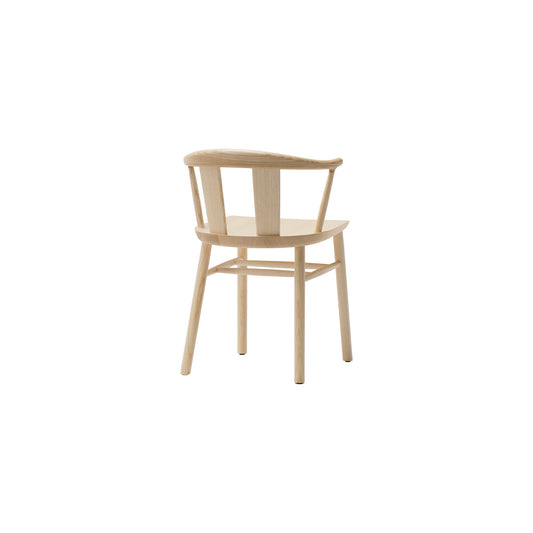
Konstantin Grcic: The new STELO chair has formal characteristics reminiscent of the Windsor chair. What was your particular interest in this historic model?
Sam Hecht: Indeed, STELO does play with history a bit. I’d say our interest is with the Windsor’s economic and adaptive model, which helped make it so prolific. It uses the ‘division of labour’ method, where each part of the chair is made in small batches by different craftspeople, and then brought together. The result is an ‘assembled’ aesthetic. Stelo adopts this ‘assemblage’ method, but capitalises on Mattiazzi’s specific techniques – that we have come to know over the years.

KG: The new chair is your fifth project for Mattiazzi. To what extent would you say that it continues your own story for Mattiazzi, which began fifteen years ago with the striking design of Branca? Or is STELO more about breaking new ground?
Kim Colin: All of our chairs stem from the nature of our curiosity – about the sourcing or behaviour of wood over time, about harnessing Mattiazzi’s special skills, and about the potential economy of structural innovation. But Stelo is different, because we’re looking back as well as forward: Stelo reinvests in a historic typology – in the roots of the Windsor version of the Captain’s Chair. Here we find something intriguing, worth exploring for how it can be shaped and made relevant for today. More than the sum of its parts.
KG: There are always two perspectives on a chair. One is the perspective of the person sitting in it, and the other is the spatial perspective – the environment and context in which the chair is placed. Could you say something about who you designed the chair for and the situations and spaces you have in mind for it?
SH & KC: Nothing leaves the studio that we do not want ourselves. Our work is however not about self-expression – Industrial Facility deliberately promotes its removal – and this very contradiction perhaps helps the work be more open to interpretation. It is for us, and also for everyone. If you like the chair, it is because it reflects how you see yourself or want to, hopefully finding both the comfort of something familiar and the tension of something new. There is another perspective that we consider – that of seeing a person sitting in Stelo and within a space. The simultaneity of this – seeing the chair with someone in it and in a space – allows us to effectively judge posture and presence together. This allows Stelo to be a chair that is enjoyed both by a person and the room.